21Jul

Learn how to disagree and fight fair by identifying and reframing the 4 Horsemen of conflict defined by John Gottman.

Conflict is a natural part of human interaction. We are all different, with unique views of the world, and. When you put two people, with different personalities, opinions, and perspectives in a situation where emotions run high and they need to troubleshoot a problem, you've got a beautiful equation for conflict.

The question is, what does the conflict look like for you? What's your template - your expectation - of how conflict is going to play out? Is it loud, angry, hostile, aggressive? Are there hateful words being said? If this is what comes to mind for you, you're not alone.

It doesn't have to be that way. 

Learn how to disagree

You don't have to see things the same way as the other person. You don't even need to agree with their perspective. Having said that, it is important that you remain respectful.

We all want to feel heard and it's normal to see our personal views as the 'right' ones. Right, however, is subjective. Just because it's different than yours doesn't make it wrong.

John Gottman's Four Horsemen

Learn how to fight fair. Express yourself with kindness, respect, and a willingness to learn. Below is a list of the four most common ways people argue. Identified by John Gottman and his wife, these "Horsemen" of conflict are predictors of divorce in romantic relationships, and can, by assessing the alternative approaches, provide a blueprint for the ways to engage in kind and constructive conflict.
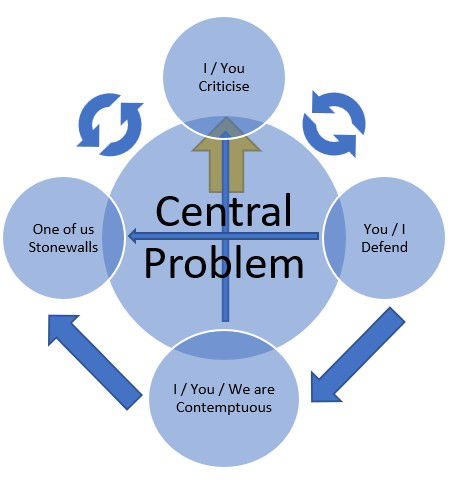
  1. Criticise them - Are you criticising or attacking your partner. Are you using a lot of “you” statements and accusatory language; blaming them for how they made you feel, what they have done wrong, etc.
  2. Defend yourself - The person defends themselves against the attack (i.e., justifying their behaviour, dismissing the claim as false/misunderstood, blaming the other person)
  3. Be contemptuous - This adds fuel to the fire and is the greatest predictor of divorce. Contempt belittles your partner and places you on a pedestal of superiority. Scoffing, sarcastic comments, eye-rolling, cynicism, mockery, hostile humour, and dismissive comments are all examples of contemptuous behaviour.
  4. Stonewall - One of the individuals shut down and withdraw from the conversation, physically or psychologically.

Instead of those four... try these

  1. Raise a complaint - Raise a complaint about an issue – one at a time – and propose a solution where possible.
  2. Accept accountability - Seek clarity and take accountability. “So, if I understand correctly, what you’re saying is… Is that right?” or “I’m not sure I understand, can you please help me understand what you mean?”, and “I can see how that would be upsetting/frustrating/disrespectful” or “I’m sorry, I completely forgot. Thank you for reminding me, I’ll do that now.” Remember that taking accountability for your actions does not mean that you are to blame for the conflict.
  3. Be kind & clear - Short-term (in the conflict) Describe your feelings and state your needs “I feel ___ about/when you ____. Can we please find a time to talk about this” or “_____ is very important to me. It would mean a lot to me if you could help me with that.” Long-term (consistently throughout the relationship) use the Magic Ratio 20(+):1(-) to create a culture of respect, kindness, and strength. Small things consistently: a kiss, a hug, a kind work, thanking your spouse for their support; choose to focus your energy on Recall the good times you have shared as well as the hard times that you have overcome; your relationship can withstand the discomfort of addressing this conflict, and it will be stronger for it.
  4. Call for a pause - Call for a pause. It takes at least 20-30 minutes for the brain to reengage after reaching the point of escalated/heated conflict. Let your partner know that you need a break. This break can serve two functions: 1) it allows both of you to regulate, which will make the return to the interaction more considered and constructive; 2) it is an exercise in trust – “I trust you to give me some space; my partner trusts me to return.” In order for the break to be effective it must be discussed and agreed upon between both partners in a low-tension setting (i.e., during neutral conversation, perhaps during to check in or in therapy). This discussion should include the timeframe of the break (no more than 60 minutes), general phrases that may be used to call for the pause, and the commitment to honour the request.

A word to the wise

  1. Take some time to identify which of the Horsemen you are most likely to use in an argument
  2. When you are in conflict, pull yourself up when you use the Horsemen, “I’m sorry, that was really critical of me. Let me try again.” – they will appreciate the sentiment.
  3. Put yourself in the other person's shoes. You may not agree with their perspective but that doesn’t make it wrong. Their feelings are just as important as yours, but their experience of the world may mean that they feel differently, or have a different opinion, than you do about the same situation.
  4. Seek understanding. When in doubt, ask a question. If you don’t understand why your partner is sensitive about a particular topic, ask them if they can help you to understand.

- Be kind & stay well. Until next time, Amylia

21Jul

Harnessing the two key factors of communication: the message and the delivery.

Message & Delivery

There are two main factors in communication:

  1. The message is what you want them to know
  2. The delivery is how you tell them what you want them to know

If the delivery contains too much 'noise' the message gets lost and the topic of discussion shifts to something that is not only completely irrelevant to the reason the interaction started, but is also completely avoidable.

Turn down the noise

At one point or another we have all been in an interaction where the person we are trying to speak to responds to the wrong part of the message, or they ignore the message entirely, choosing instead to educate you on the fact that "It's not what you said, it's how you said it". 

Before you know it, the conversation has been dragged away from the issue you raised and has become an argument about how you made them feel. This leaves both parties feeling frustrated, unheard, and wondering "Why do I bother if it's only going to end in an argument?" 

There are a number of solutions to this issue, but one of them is finding your volume dials and learning which noises to highlight, and which to reduce:

  1. Turn the volume up on the music: This is the content, the issue that you want to address: your requirement, your needs, your feelings, your concerns.
  2. Turn the volume down on the white noise: This is the hostility, snark, disrespect, contempt, blame, and accusation (See the article on the 4 Horsemen). 

I want to emphasise something here - these 'white noise' factors come from a very valid place - after all, you're not raising a sensitive issue because it doesn't mean anything to you. 

However, the validity of the 'hot' emotions triggered by the situation doesn't excuse poor behaviour. You are in control of your thoughts, feelings, actions, and words; turn the volume down on the white noise, and your message will be heard loud and clear.

Picking the right volume for me

Just as there is a sweet spot with your radio volume, there is one for your communication as well:

  1. Too low and you will struggle to convey the importance, urgency/of the message. It comes across as passive and 'meh'. 
  2. Too high and it can come across as aggressive/demanding/controlling, and you find yourself with another delivery problem.

Take a moment and think about your message and delivery. Do they need fine tuning, or a volume adjustment?

- Be kind & stay well. Until next time, Amylia

20Jul

Empower yourself by taking note of the things in your world that you have control over.

There's nothing worse than feeling like a situation is out of your control. The feeling of being trapped or taken advantage of is uncomfortable, and for some, triggering. Taking the time to focus on the things that are within your control can create a sense of empowerment and confidence. No matter the circumstances you are always in control of precisely four things.

You can control...

What you SAY: Are you speaking with kindness? Are you being critical or judgemental? 

What you THINK: Your thoughts influence you feelings, actions, and words, so it's important to think well. Are you being kind to yourself. Are you holding onto hurt? Are you inflaming an already difficult situation?

What you DO: Are your actions thoughtful and intentional? Are you considering the impact that your actions may have on the people around you?

How you FEEL: Unlike emotions, your feelings are able to be regulated. Your feelings are your responsibility. Someone else's actions may hurt your feelings, however you are responsible for what you do afterwards.

The blame game

Change your focus from 'blame/fault' to 'accountability'. Your bubble contains your aspects of control (your thoughts, words, actions, and feelings); you are not in control of other people's aspects and they are not in control of yours. 

To blame someone suggests that they had control over a response that you had. To take accountability is to own your aspects of control, communicate your thoughts to the people you interact with, and regulate yourself. When you accept accountability you also accept that regardless of external influences, you are ultimately responsible for what you do with the results of that influence. 

If you can accept that a situation is inside your bubble of control, you acknowledge that you have the capacity to change it. If you believe that your reactions are the fault of another person, you no longer perceive it as being within your control, meaning that you don't have the ability to change it. 

This leaves you feeling helpless and like you are at the mercy of the people around you, which can increase anxiety, stress, and depression.

Final word...

  1. Speak to yourself with kindness
  2. Show compassion to yourself and others
  3. Be patient
  4. Think before you act
  5. Stay out of a righteously indignant and/or innocent victim mindset
  6. Enforcing boundaries is a necessity, not a luxury


-Be kind & stay well. Until next time, Amylia


19Jul

Hey-hey, and welcome to Choices Therapy! My name is Amylia and I've been a therapist on the Gold Coast for almost five years. 

I'm 32 and I have an eleven and a half year old daughter. I did my bachelors degree in psychology (no, 'm not a psychologist) and my masters degree in counselling (yes, I am a counsellor). I swear, I make mistakes, I am constantly asking myself if I am doing a good job as a mother, and I worry that I do not do enough as a partner. I have anxiety and depression, a crazy case of imposter syndrome, and sometimes it feels like my ducks are squirrels and they aren't in a row, but running around like Hemmy from Over the Hedge - with less direction. 

Why is this important? Because I am human, I am flawed, and it's okay. 

Not every therapist is for everyone, and I may not be for you; and that's okay. Having said that, I have worked with a lot of clients over the years, and I know that my approach to therapy is a great fit for a lot of people. I am real, authentic, and I have first-hand experience with a lot of topics that my clients are seeking help for. 

I pride myself on my professionalism and client care, and my passion for my job is second to none. I combine academic education, life experience, and client observation to provide my client's with the most comprehensive and personalised treatment that I can. 

Some of my clients have seen therapists in the past (psychologists, counsellors, psychiatrists), and some are trying therapy for the first time. Irrespective of experience, my aim is to make the consultation times with me as personalised as possible. We are all different,  and regardless of common themes - anxiety, stress, abuse, relationship breakdown - individual circumstances and their impact are completely unique. 

You have reached out for help, guidance, and support, and you deserve to be treated as the individual you are.

My approach

The way I see it, therapy can be a confronting process. The simple act of making the appointment is disconcerting enough for a lot of people, and understandably so. 

I want to make it as pain-free as possible. I do this by treating sessions more as 'constructive conversations'. This removes the stigma associated with therapy and allows for the development of a rapport that cultivates a non-judgemental environment to discuss concerns without filters or bias. 

The professional & the expert

I am the professional, but you are the expert. An area that clients tend to struggle with in therapy is feeling like they are being analysed and treated as a case study. Like they are being scanned and assessed for the boxes that fit their problems. 

I think that the individuality of the client requires individualised treatment. Sure, there are benefits to standardised descriptions and treatments for common concerns; they provide a set of guidelines. Unfortunately for some, these guidelines are relied upon to the exclusion of the person actually sitting in front of them. 

This limits the benefits that come from therapy and alienates the client from reaching out for help again in the future, because, "What's the point in paying for therapy when I could get the same outcome by reading a textbook." Honestly, I couldn't agree more.

Commitment & requirement

When we work well together, we can achieve great things. However, as is the case with any pairing, if only one of us is engaging in the process the results are unpredictable, and often times disappointing.

As the professional, my commitment to you is that I give you my all. Every piece of experience, knowledge, professional observation, and personal point of reference will be used to ensure you have the most productive and rewarding therapeutic experience I can offer.

This leads me to my requirement, which is that you commit the same amount of energy and passion to your own growth, healing, and recovery as I do to facilitating it. Ultimately, we spend an hour together a week, maybe a fortnight, and eventually it will be spaced out even further. If you want the results, you must do the work in and out of our consultations.

I am big on personal accountability. If I require you to do something between sessions, trust that it's for both a reason and your benefit. If the exercise doesn't work, the worst thing that can happen is that we learned something that doesn't work for you. 

In closing...

You remember the old Nutri-Grain ad, "You only get out what you put in," the same rule applies to therapy. We all move through various stages of change, including the stages associated with preparedness to act on the desire to change. 

Sometimes the best start is making contact. If you find that actioning the change is too much for where you are, tell me. There is no pressure, and rushing or forcing change can have the opposite effect. Pressing pause on the therapeutic process means the connection and rapport have been established, and you can return to it when you're ready. 

What we know is that what you are currently doing isn't working for you. You've come to me because you believe that I can help. 

- Be kind & stay well. Until next time, Amylia.

19Jul

Conflict is one of the more common reasons that people come to speak with me. It could be a couple having troubles, or a communication breakdown with a supervisor/employee. Either way the challenge is the same. How do I bring up, or respond to, a conflicted topic? 

You'll probably fall into one of two types of people:

  1. The Protector: "I don't want to say anything because I'm worried that I'll snap."
  2. The Avoider: "I want to say something, but I don't know how."

Regardless of the type, the response is the same.

The Magic Question

"Can you help me to understand?"

It's neutral, it's simple, it's easy to remember. It's non-confrontational, so it's not likely to get the other person's back up and result in a defensive reply, and it's emotionally dispassionate which means that it is not likely to fuel your emotional reactivity. 

Prefaced with a reflective statement, this magic question prompts the other person to consider the message they are trying to convey and reframe their request.